
Is Your Child’s Head Injury Serious? Warning Signs Every Parent Should Know
Is Your Child's Head Injury Serious? Warning Signs Every Parent Should Know Most bumps to a child’s head are minor,...
Jaydeep Hospital – Best Pediatric Superspeciality Hospital In Ahmedabad
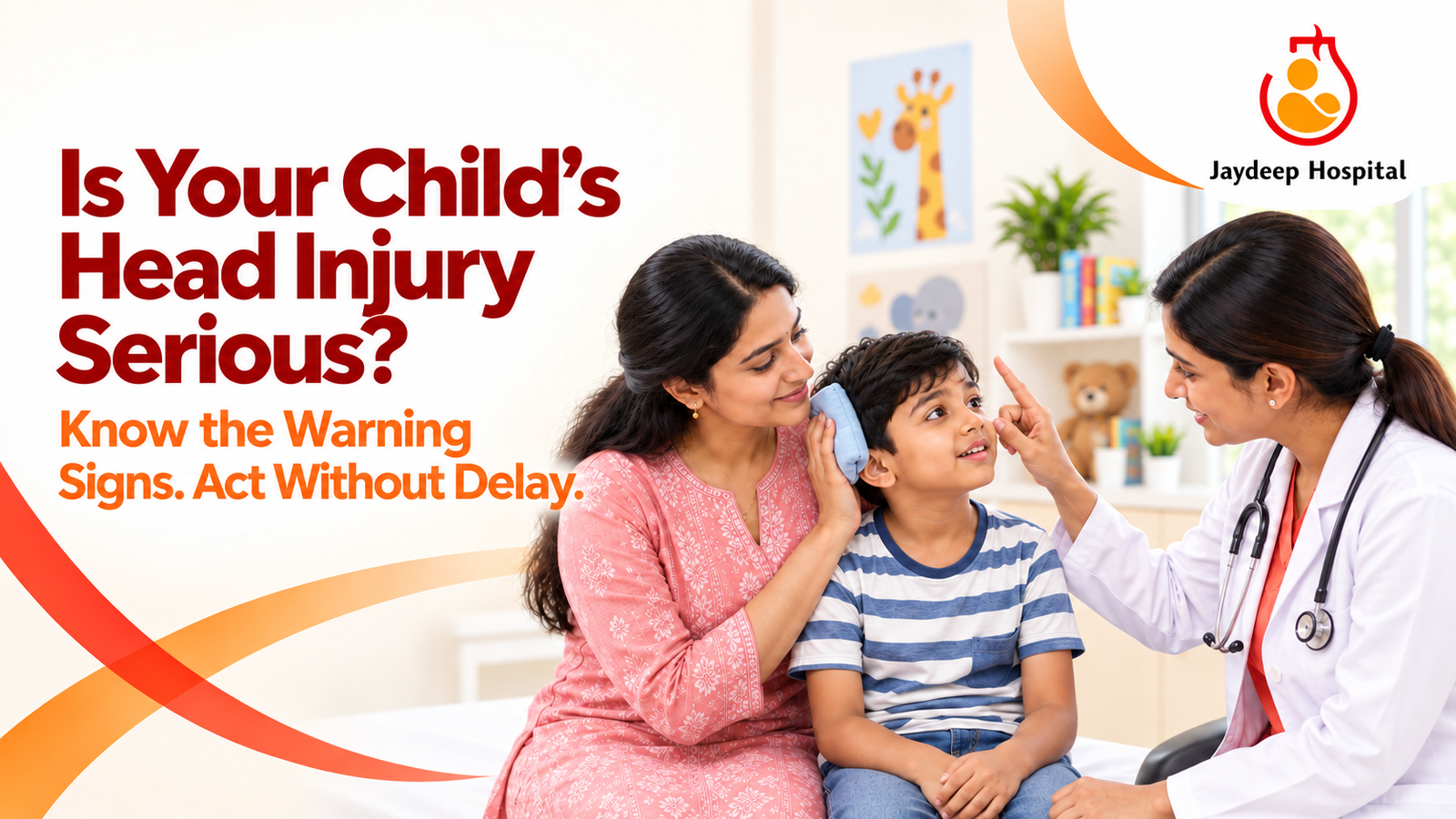
Most bumps to a child’s head are minor, but some require urgent medical attention. Take your child to the nearest emergency department immediately if they lose consciousness, have a seizure, vomit repeatedly, become unusually sleepy or confused, develop weakness, have difficulty walking or speaking, or experience a worsening headache. Unequal pupils, blood or clear fluid from the ears or nose, and unusual behavior are also serious warning signs. A child can have a significant head injury even without losing consciousness, so parents should monitor symptoms carefully after any forceful fall, collision, or blow to the head.
Falls are common during childhood. Babies may roll from beds, toddlers may fall while learning to walk, and older children may experience injuries during cycling, sports, playground activities, or road accidents.
Many of these incidents cause only a minor bump or bruise. However, the brain and nervous system continue developing throughout childhood, and symptoms of a concussion or more serious injury are not always immediately visible.
Some symptoms appear within minutes, while others may emerge several hours or even days later. Parents therefore need to observe changes in the child’s behaviour, movement, speech, feeding, sleep, memory, and overall responsiveness after an injury.
Babies and children who cannot clearly describe how they feel require especially careful monitoring. A child may not be able to explain dizziness, blurred vision, nausea, confusion, or sensitivity to light.
A head injury can occur after:
The injury may affect only the scalp, or it may involve the skull and brain. A scalp injury can produce noticeable swelling because the scalp has a rich blood supply. A large bump does not automatically mean the brain is injured, but the child’s symptoms and the way the accident occurred must still be considered.
A concussion can occur even when there is no visible wound or swelling.
A concussion is a type of traumatic brain injury caused by a bump, blow, or jolt to the head. It can also result from a forceful impact to the body that makes the head and brain move rapidly back and forth.
This movement may temporarily affect brain function. A child with a concussion may experience changes in thinking, learning, balance, emotions, behaviour, and sleep. Loss of consciousness is not required for a concussion to occur.
Most children recover from concussion within approximately two to four weeks, although some experience symptoms for longer. A medical assessment is important because a healthcare professional can evaluate the severity of the injury and guide the child’s safe return to school, play, and sports.
Seek emergency medical care immediately if your child develops any of the following symptoms after a head injury:
These signs may indicate bleeding, swelling, skull fracture, pressure on the brain, or another significant injury. Do not wait for the symptoms to improve naturally.
Recognising concussion symptoms in children under four can be difficult because they may not be able to explain what they are experiencing.
Parents should look for:
A baby may initially appear well but develop symptoms later. Parents should have a low threshold for seeking medical advice after a significant impact, particularly in babies under six months or when the event was not clearly witnessed.
Arrange prompt medical assessment when:
A medical professional should determine whether the child needs observation, imaging, treatment, or safe monitoring at home. The severity of a head injury can change, which is why repeated assessment may be required.
First, remain calm and assess whether the child is awake, responsive, and breathing normally.
When the child is alert, interacting normally, and has no emergency warning signs:
Paracetamol may be used for discomfort when appropriate for the child’s age and according to medical or package dosing instructions. Parents should seek professional guidance before giving other medicines after a head injury, particularly if there is concern about bleeding
If the child is unconscious, has significant neck pain, or was involved in a high-impact accident:
Moving a child with a possible neck or spinal injury may worsen the damage. Emergency professionals should manage transportation whenever possible.
The doctor will ask how the accident occurred, how far the child fell, what surface they landed on, whether they lost consciousness, and whether vomiting, seizures, memory problems, or behavioural changes occurred.
The examination may assess:
Depending on the findings, the child may be discharged with home-monitoring instructions, observed in hospital, or investigated further.
No. Most minor head injuries do not require a CT scan.
Doctors consider the child’s symptoms, age, examination, mechanism of injury, loss of consciousness, vomiting, drowsiness, skull-fracture signs, and neurological findings before recommending imaging.
CT scans are valuable when there is a meaningful risk of bleeding or structural injury, but they expose the child to radiation. Medical guidelines therefore recommend using imaging when specific clinical risk factors are present rather than scanning every child with a bump on the head.
Parents should not insist on or reject a CT scan without discussing the benefits and risks with the treating doctor.
Symptoms may not be obvious immediately after an injury. During the following hours or days, parents may notice:
Parents should inform the child’s doctor if new symptoms appear or existing symptoms worsen.
Recovery should be gradual and guided by symptoms. The child may initially need reduced physical and mental exertion, followed by a progressive return to normal routines.
Many children can return to school within one or two days, sometimes with temporary adjustments such as shorter days, rest breaks, reduced homework, extra time for assignments, or less exposure to bright and noisy environments. Prolonged complete isolation is not generally the goal; school support should be matched to the child’s symptoms.
Children should not return to contact sports, cycling, rough play, or activities that risk another head impact until medically cleared. A second injury before the brain has recovered may result in more severe or prolonged problems.
Return to sport should occur through a step-by-step progression supervised by an appropriate healthcare professional. If symptoms return during a stage, the child should stop and contact the treating provider.
A serious childhood head injury may require coordinated assessment by emergency physicians, paediatricians, radiologists, intensive-care specialists, and paediatric neurosurgeons.
Families searching for a pediatric neurosurgeon in Ahmedabad can consult the Pediatric Neurosurgery Department at Jaydeep Hospital. The hospital provides specialised care for neurological conditions involving the brain, spine, and nervous system, including head injuries and complex pediatric neurosurgical concerns.
Jaydeep Hospital’s main centre is located in Naranpura, Ahmedabad. The Naranpura centre provides 24-hour inpatient, outpatient, emergency, diagnostic, surgical, NICU, and PICU support for newborns and children.
Prompt evaluation at Jaydeep Hospital can help determine whether the child needs observation, imaging, concussion management, intensive monitoring, or specialist neurosurgical care.
A head bump may be serious if the child develops repeated vomiting, increasing sleepiness, confusion, seizure, worsening headache, poor balance, weakness, unequal pupils, unusual behaviour, or loss of consciousness. Seek emergency care when any of these signs occur.
Vomiting can occur after a head injury, but it should not be ignored. Repeated vomiting is an emergency warning sign. Even a single episode should be discussed with a medical professional, particularly in a baby, after a forceful accident, or when accompanied by other symptoms.
Yes. Most concussions do not require loss of consciousness. Headache, dizziness, confusion, slowed responses, balance problems, memory difficulties, mood changes, or altered sleep may indicate a concussion.
Parents should watch the child closely during the first 24 hours and continue looking for delayed symptoms over the following days. Follow the monitoring period and instructions provided by the child’s doctor, as recommendations depend on the accident and examination findings.
A child with a suspected or diagnosed concussion should not return to sports on the same day. Return should happen gradually and only with healthcare-provider approval.
Contact the child’s doctor when symptoms worsen at any time or continue beyond the expected recovery period. Specialist referral may be considered when concussion symptoms have not resolved within two to four weeks or when the child has experienced multiple concussions.
Most childhood head injuries are minor, but parents should never judge severity only by the size of the bump or whether the child lost consciousness.
Monitor the child’s behaviour, alertness, movement, speech, feeding, vision, balance, and symptoms carefully. Repeated vomiting, seizures, increasing drowsiness, worsening headache, weakness, confusion, unequal pupils, abnormal behaviour, or blood or clear fluid from the ears or nose require immediate emergency care.
When something does not feel right, seek medical assessment. Parents know their child’s normal behaviour best, and early evaluation can identify serious injuries while reassuring them and providing appropriate recovery guidance for minor ones.
This article is intended for general educational purposes only. It does not replace emergency care, physical examination, diagnosis, or personalised advice from a qualified paediatrician or pediatric neurosurgeon.
Is Your Child's Head Injury Serious? Warning Signs Every Parent Should Know Most bumps to a child’s head are minor,...
Persistent Cough or Wheezing in Children - When Should Parents Worry? A cough that continues after a cold is common,...

તમારા બાળકનું ઓપરેશન: પેડિયાટ્રિક સર્જન (બાળરોગ સર્જન) જ શા માટે શ્રેષ્ઠ છે? "બાળકો માત્ર કદમાં નાના નથી હોતા, તેઓ કુદરતની...